


Pay transparency in a small company — what you must do
Since 24 December 2025, every employer in Poland, including a company with just a few employees, must give a candidate the pay or pay range (widełki płacowe) before hiring. More obligations will come with the act implementing Directive (EU) 2023/970. Below you will find a short list and free tools.
Legal status as of 10 November 2026
Already in force (since 24 December 2025)
- Pay range for the candidate. Information on the starting pay or pay range, based on objective, gender-neutral criteria — in the job advertisement; if it is not there, before the job interview; if there was no interview, before the employment relationship begins (art. 18³ca § 1–2 of the Labour Code (Kodeks pracy)).
- In advance and in writing. On paper or electronically, so that negotiations are informed and transparent.
- Neutral job advertisements and job titles. E.g. "Bricklayer (m/f)", "Driver (m/f)"; recruitment without discrimination (art. 18³ca § 3).
- No questions about past earnings. The employer may not ask for information about pay at the current or previous workplaces (art. 22¹ § 1 pkt 6).
For breaches of labour law, the National Labour Inspectorate (PIP) may impose a fine — currently from 1,000 to 30,000 zł.
What the new act will bring (draft, not yet passed)
- Job evaluation at every employer based on 4 criteria: skills, effort, responsibility, working conditions — and pay structures.
- The employee's right to information about their own pay and the average pay of women and men doing the same work or work of equal value; in companies with fewer than 50 employees — on request, within 30 days (according to the draft).
- A ban on clauses forbidding employees to disclose their own pay.
- A pay gap report (luka płacowa) — from 100 employees.
- Entry into force: 6 months after the act is published, so not earlier than 2027. The deadline for implementing the directive passed on 7 June 2026.
Free tools
- Pay range in a job advertisement — template and generator
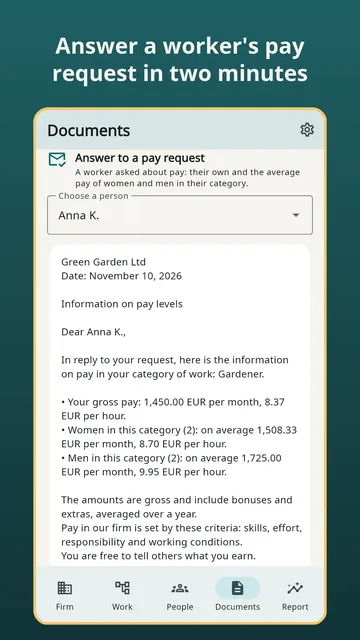
- Template reply to an employee's request for pay information
- Pay gap calculator (mean and median)
Your whole company in one app
Jawność for Android: job categories based on 4 criteria, pay ranges for every position, replies to employee requests with one tap (in Polish, Ukrainian, English and Russian) and a pay gap report. No account and no subscription — your data stays on your phone. Free for up to 5 people.
Get Jawność on Google Play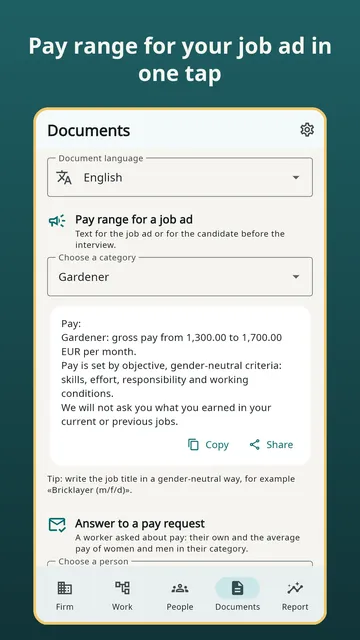
Other free tools
- Pay range in a job advertisement — template and free generator
- Template reply to an employee's request for pay information
- Gender pay gap calculator
Frequently asked questions
Does a company with 5 employees have to give pay ranges?
Yes. Art. 18³ca of the Labour Code applies to every employer, regardless of the number of employees, when recruiting for work under an employment relationship.
Must the pay range be in the job advertisement itself?
Not always. First in the advertisement; if it is not there — before the job interview; if there was no advertisement or interview — before the employment relationship begins. Always in advance, on paper or electronically.
Does a small company have to prepare a pay gap report?
Under the directive and the Polish draft, the report applies to employers with at least 100 employees. A smaller company can calculate the gap voluntarily — it helps in answering employees' questions.
From when can an employee ask about the average pay of women and men?
This right comes from art. 7 of Directive (EU) 2023/970. The Polish act that will introduce it had not yet been passed as of 10 November 2026. Preparing your answer now is good practice.
Can I forbid employees from talking about their pay?
The amendment of 4 June 2025 did not introduce such a ban. A ban on pay confidentiality clauses is provided for by the directive (art. 7(5)) and by the draft of the new act.
Sources
- Ustawa z 4 czerwca 2025 r. o zmianie ustawy – Kodeks pracy, Dz.U. 2025 poz. 807
- Dyrektywa (UE) 2023/970 (EUR-Lex)
- Projekt ustawy (UC127) — Rządowy Proces Legislacyjny
These materials and generators help you prepare texts. They are not legal advice and give no legal guarantee. Regulations change — before using them, check the current legal position or consult a lawyer.